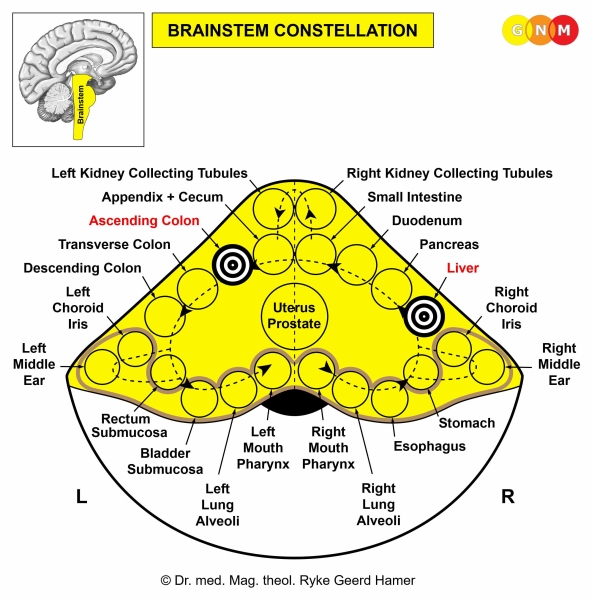
The constellation is established, the moment the second conflict registers in the opposite brain hemisphere. The conflicts could also occur simultaneously. The constellation can be permanent or recurring due to tracks or conflict relapses.
This brain scan of a 7-year-old girl shows a Brainstem Constellation that has already been resolved.
The story: The father of this young girl owned a small grocery store in a village in Germany. One day he learned that a supermarket will open right next to his shop, which was a big concern for him. When the girl overheard her father saying to her mother, “We are going to starve!”, she took this literally and suffered a starvation conflict (registered in the liver parenchyma relay on the right side of the brainstem). The uterus conflict (left brainstem hemisphere) is associated with an “ugly conflict with a male”; in this case, with the “mean” supermarket owner who threatened the “survival” of the family.
At the time the CT was taken, the girl was no longer in constellation. The brain edema (PCL-A) in the liver relay (showing dark) indicates that the starvation conflict has been completely resolved. The uterus conflict, however, is still partly active. Luckily, the cell proliferation (“cancer”) in the liver and in the uterus was never detected. (Source: Ryke Geerd Hamer, Vermächtnis einer Neuen Medizin, Vol. 2, p. 110)
The Brainstem Constellation manifests itself as mental confusion (see also Kidney Collecting Tubules Constellation), as not being able to think clearly, as being incapable of any reflections, unresponsive, and mentally frozen. Typically, the person has a vacant look and is staring into space. The purposeof the constellation is to make the conflicts inaccessible in order to be better able to cope with the distress. NOTE: The mental absence should not be mixed up with a depression.
The degree of the confusion and mental remoteness is proportional to the intensity of the conflicts. A short and moderate constellation is noticeable as losing the train of thought or forgetting what one wanted to say (having “a blank”). A strong constellation, however, can cause a severe mental confusion (see Alzheimer's disease), or a delirious state. Here, we also find what is known as catatonic stupor, marked by a greatly diminished responsiveness, rigidity (stiff posture), inability to speak, and unawareness of one's surroundings (compare with autistic stupor).